
Global Innovation Index 2024: encouraging signs for Madagascar?

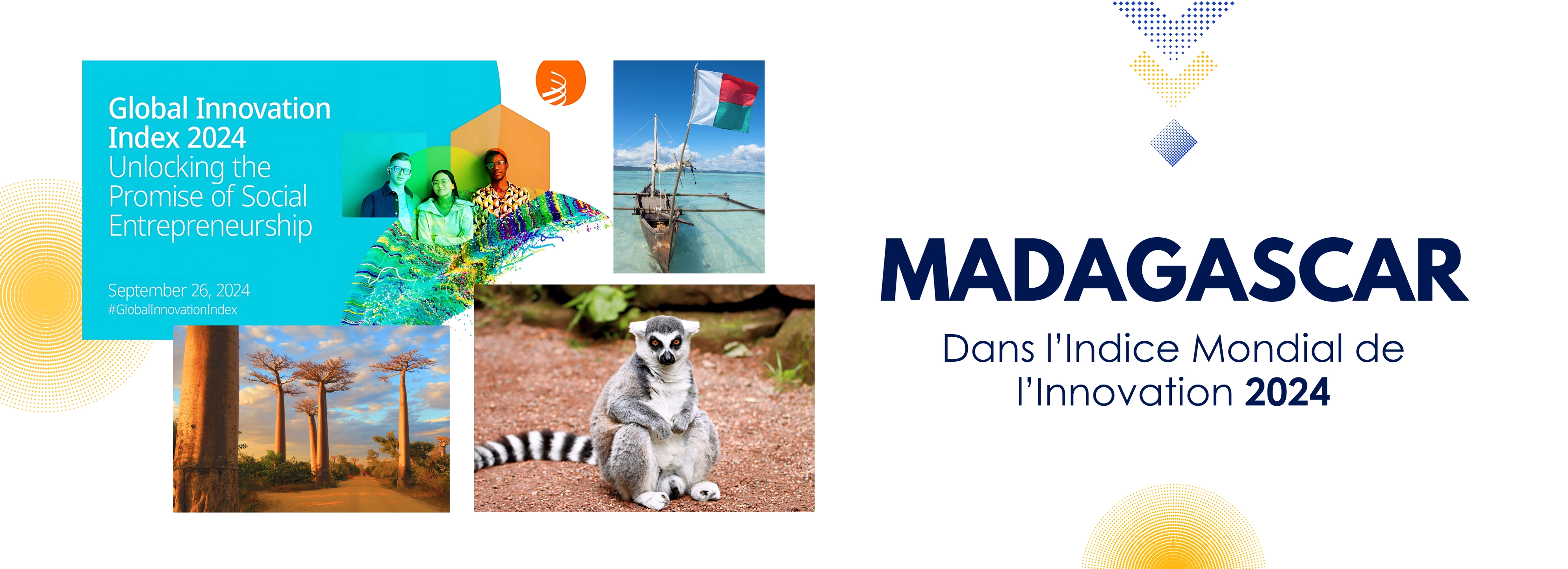
Despite an unfavorable context, Madagascar still managed to rank ahead of several countries in the 2024 global innovation ranking. This performance is a promising sign which suggests considerable development potential for the future.
As a reminder, the Global Innovation Index is an annual ranking that assesses the ability of countries to generate and exploit new ideas. It is based on various criteria such as investments in R&D, education, intellectual property protection and digital development.
This ranking is published jointly by WIPO (World Intellectual Property Organization), Cornell University and INSEAD (European Institute of Business Administration), and is based on both subjective and objective data from several sources, including the International Telecommunications Union, the World Bank and the World Economic Forum.
In this article, we will focus on Madagascar's positioning in this ranking to better understand its innovation capabilities and consider its future in this area, especially in the IT sector.
1. Madagascar: where is the Big Island in the race for global innovation?

Ranked among the poorest countries in the world with a declining GDP, Madagascar struggles daily with poverty, unemployment and failing infrastructure. The challenges are numerous and complex: limited access to drinking water, electricity, fragile health system, high unemployment rate... The list is very long.
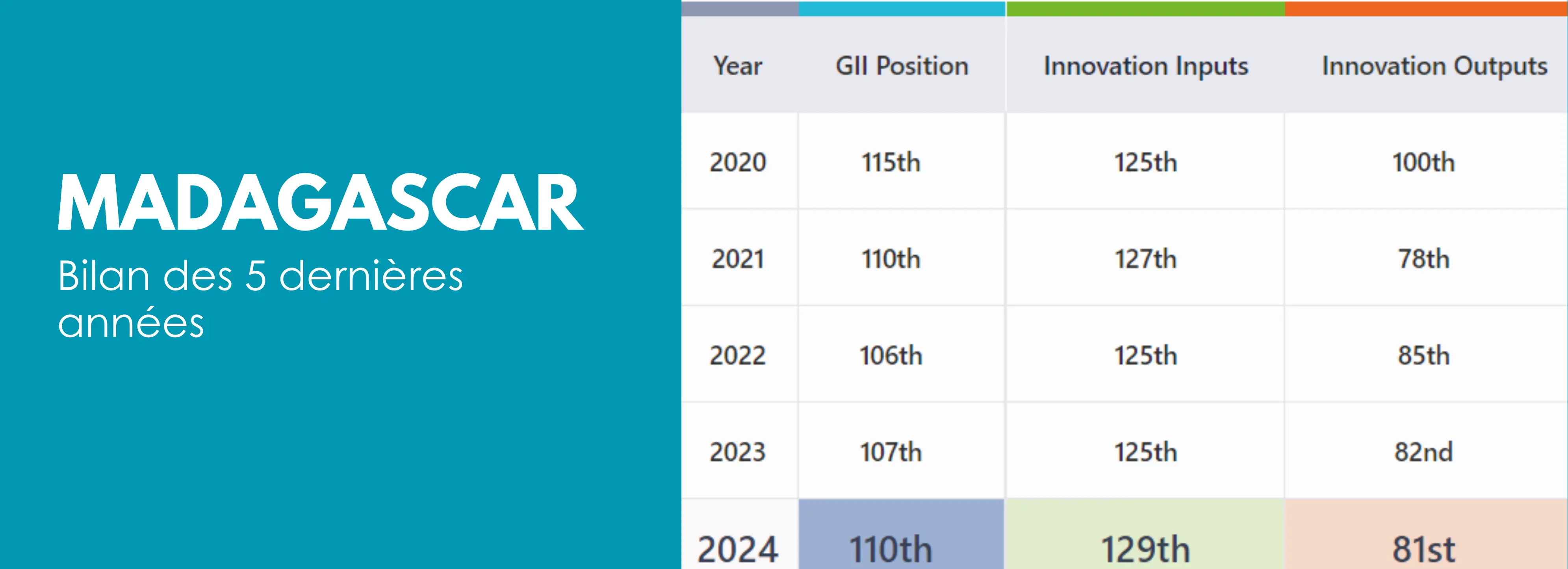
And yet, Madagascar managed to rank 110th out of 133 countries in the 2024 global innovation index, published on September 26, 2024. A modest position which hides immense potential.
Indeed, Madagascar has proven its ability to progress and stand out in its category. Advances in certain sectors represent levers to accelerate the economic and social transformation of the country.
2. Results for Madagascar: overall and comparative ranking
(Source: https://www.wipo.int/gii-ranking/en/madagascar)
Strengths and weaknesses:
Madagascar is building the foundations of a more innovative economy, in particular thanks to its creative potential and its desire to catch up technologically. However, sustained efforts are still necessary to improve its infrastructure, develop its research capabilities and strengthen its innovation ecosystem.
3. Land of unexplored IT talents: lack of visibility or stolen opportunity?
Madagascar has considerable economic and social potential. However, it faces many problems, including that of brain drain, particularly in the information technology (IT) sector. This phenomenon, although regrettable, highlights an interesting paradox: how can a country with limited resources train high-level talent while being unable to retain them?
Malagasy universities and engineering schools train thousands of young graduates skilled in IT every year. These talents, often bilingual and endowed with a great capacity for adaptation, are highly sought after internationally.
This human wealth does not go unnoticed. Mauritius, for example, has understood the benefit of relying on this pool of talent to propel its digital sector, today ranked 57th in the world in terms of innovation. This strategic choice reflects the growing dependence of countries in the region on Malagasy skills.
Even France, 12th world power in terms of innovation, is no exception to this rule. Many French companies, keen to strengthen their competitiveness, are recruiting more and more Malagasy engineers, particularly in the technology and digital services sectors. Madagascar thus appears to be an essential partner to meet the skills needs of these economic powers.
But why are these talents leaving Madagascar?
The reasons are multiple: lack of professional opportunities, unattractive salaries, political instability, etc. Young Malagasy graduates aspire to a better life and more promising careers.
The departure of these talents represents a considerable loss for the country. Not only does it deprive the Malagasy economy of key skills, but it also leads to an emigration of human capital, which can slow down the country's development in the long term.
How can we reverse this trend?
To retain these talents and develop a thriving digital ecosystem in Madagascar, it is necessary to put in place ambitious public policies and create an environment conducive to innovation and entrepreneurship (development of digital infrastructure, investment in research and development, establishment of business incubators and accelerators, etc.)
AKATA GOAVANA is fully part of this dynamic by offering young local and national talents opportunities for professional development, competitive salaries and a stimulating work environment, thus promoting their local roots and their contribution to the country's economic growth.
4. Conclusion
In conclusion, Madagascar has immense potential in terms of innovation. However, to exploit this potential, it is necessary to establish an environment conducive to the emergence of a dynamic digital ecosystem. By retaining its talents and promoting innovation, Madagascar will be able to position itself as a major player in the digital economy in Africa.
But we do agree on one thing, right? The example of Madagascar reminds us that innovation is not reserved for rich and developed countries. Even in the most difficult contexts, it is possible to be creative and shine, even just a little bit, on the world stage.
AKATA GOAVANA actively contributes to Madagascar's innovation by offering services aligned with international standards. We draw inspiration from global best practices in innovation by integrating the latest technological advances into our processes to meet the specific challenges of our customers globally.
We ensure their satisfaction thanks to our expertise in software development, AI, cybersecurity, UI/UX design, DevOps and Cloud computing.
Entrust us with your projects, even the most complex — that’s our true specialty.